Start With What You Need To See
CCTV installation should begin with a question about each view. Do you need to see that somebody entered a yard, recognise a regular visitor, or capture usable detail at a doorway? These are different tasks and may need different lenses, positions and lighting.
We plan CCTV for Bradford shops, offices, industrial premises and public-sector buildings around those tasks. A wide view can help you understand an incident, while a tighter entrance view may be needed for identifying detail. Buying extra cameras without deciding their purpose often leaves the same blind spots in place.
Tell us about delivery routes, shared access, boundary disputes or previous incidents when you enquire. You do not need to send sensitive footage through the form. A description of the problem and the type of property is a useful starting point.
Cameras, Recording And Remote Viewing
An IP system connects cameras to a network video recorder or suitable managed recording platform. Power over Ethernet can carry data and power along a compatible cable, but cable distance, switches and network capacity still need checking. Existing coaxial systems may offer a reuse route where equipment and image quality remain suitable.
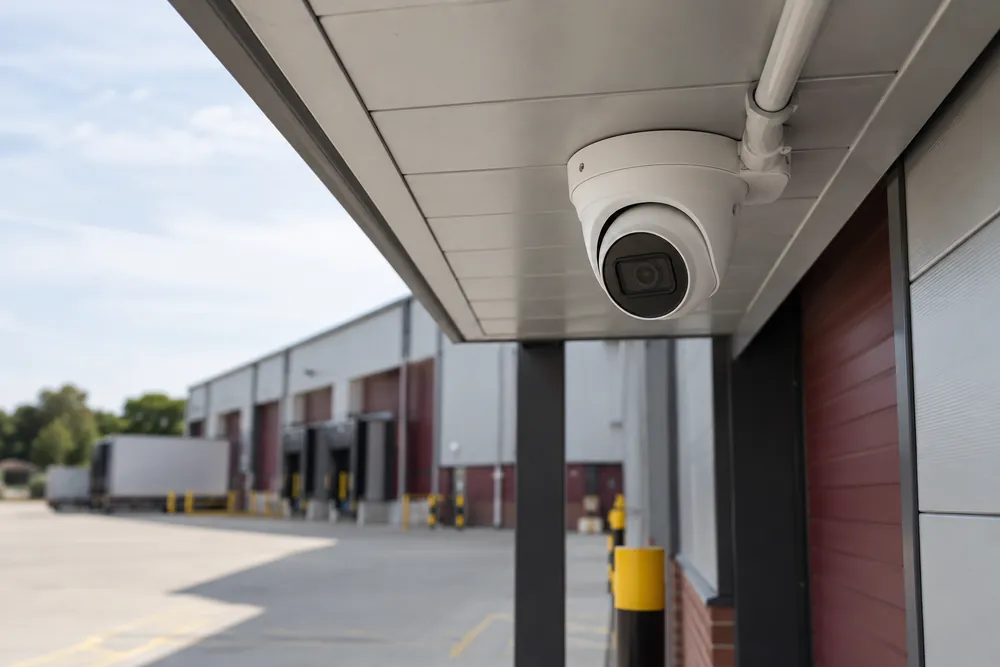
A turret, dome or bullet housing is chosen for the environment and mounting position. Lens choice matters more than the shape of the camera, and reflective windows, bright doorways and headlamps can affect the picture. Infrared light can reflect back from walls, cobwebs and nearby surfaces.
Remote viewing should use individual accounts and supported software. We discuss who needs access, how access can be removed and what happens when the internet connection fails. A working app is useful, but the recorder must also be checked for reliable local recording.
Privacy And A Clear Recording Purpose
Business CCTV is subject to data protection requirements where people can be identified. Visible signs and controlled access to images are part of the responsibilities described in government guidance. A camera layout should avoid collecting more of neighbouring premises or public space than its purpose needs.
GOV.UK: Using CCTV ↗Retention should be justified by the purpose of the recording rather than a storage setting chosen by habit. Landlords and facilities managers should also review cameras that record beyond the site boundary. We discuss framing and privacy masking so the specification reflects the actual scene.
ICO: Surveillance And Data Protection ↗Your Installation, Step By Step
First, the survey records the areas of concern, practical cable routes and available power. Landlord permission and access arrangements are checked before drilling or attaching equipment. Camera positions are then proposed against a written coverage brief.
Next, the equipment schedule sets out lenses, recording capacity and any network work. Installation includes suitable fixings, tidy cable containment and weather protection where required. Work near busy entrances needs planning so customers and staff can still use the building safely.
Commissioning checks live views, playback, timestamps and a sample export. We also check low-light performance where the agreed scope requires it. Handover should leave you able to retrieve footage and manage authorised users without depending on a single personal account.
What Affects CCTV Installation Cost
Camera count is only one part of a CCTV quotation. Mounting height, access equipment, cable length, difficult wall construction and the condition of existing wiring all affect the work. Recording capacity depends on image settings, activity and your justified retention requirement.
Ask whether the quote includes a recorder, storage, network changes, remote viewing setup and staff instruction. Any cloud storage, connectivity or ongoing support charges should be stated separately. A survey is needed before a fixed scope can be agreed.
If you already have a system, list its make and the problems you can see. We can discuss whether an upgrade, an additional view or a maintenance visit is the sensible next step. See our CCTV maintenance service for faults and routine checks.
Prepare For A CCTV Survey
Walk the property and note the views you would want to retrieve after an incident. Identify doorways, vehicle approaches and places where a person could leave the camera view. Take account of doors being open as well as closed.
Make a list of who should be able to watch and export footage. If somebody else manages the network or owns the building, involve them before equipment is ordered. This helps resolve permissions, account ownership and installation access while there is still time to change the proposed layout.